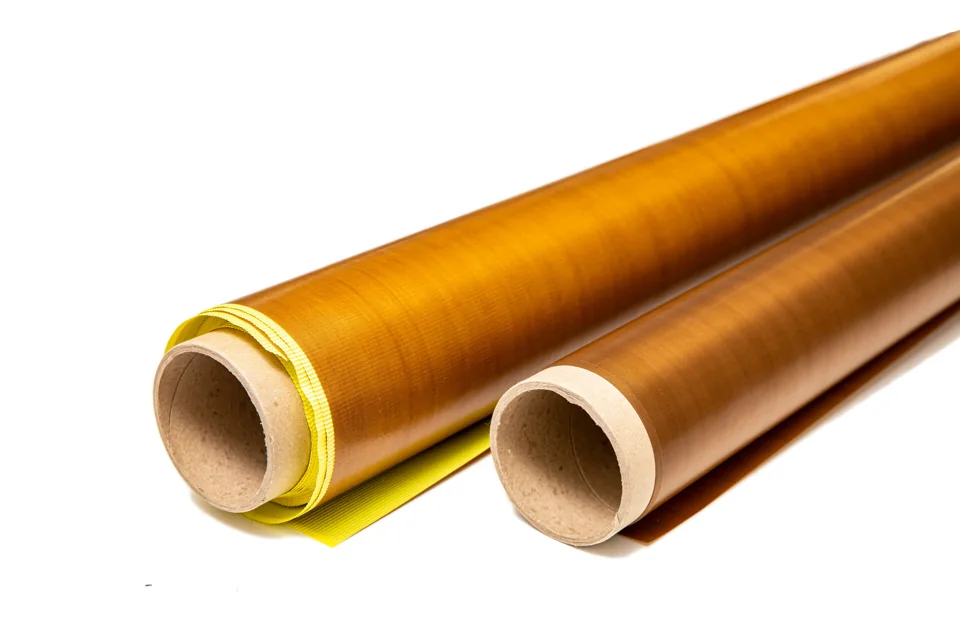
PTFE sheet, tape or conveyor belt?
Choose according to the material's function in the equipment. For self-adhesive versions, also check adhesive suitability for the substrate and operating conditions.
| You need to | See | Information for an enquiry |
|---|---|---|
| Cover a contact surface | PTFE sheets | Thickness, width, length, attachment and operating temperature. |
| Renew a narrow release layer | PTFE tapes and self-adhesive tapes | Contact width, thickness, roll length and attachment method. |
| Convey products through a line | PTFE conveyor belts | Width, circumference, joint, tracking and required airflow. |
Compare properties and applications of specific PTFE constructions.
Mesh belts for airflow
Mateos supplies mesh belts based on glass or aramid fibre in widths up to 5 000 mm. Listed mesh openings are 1 × 1, 2 × 2, 4 × 4, 6 × 6 and 8 × 8 mm. Applications include textile production, printing, woodworking and shrink tunnels. Mesh size must also be chosen according to the size of the carried product.
Solid belts and machine tracking
Solid belts are offered in widths up to 5 000 mm and thicknesses of 0.04–2 mm, with smooth or textured surfaces. The supplier lists mechanical or permanent joints and PTFE sheet edge reinforcement. For lateral tracking it lists PTFE buttons, steel eyelets or buttons, and silicone or aramid cords. Specific tracking is selected according to the machine, rather than belt width alone. Applications include automotive and photovoltaic production, woodworking and carpet manufacturing.
Laminated belts with a closed surface
The fabric is additionally coated with a PTFE film. Mateos describes a surface that limits penetration of fats, chemicals and aggressive vapours into the belt structure. It specifies widths up to 1 500 mm and thicknesses of 0.1–0.5 mm. Application examples include tortilla production, grilling and polymer processing. For a particular chemical or food contact, request confirmation of suitability for the supplied version.
Temperature depends on belt construction
Glass-based mesh and solid belts have a specified continuous operating temperature of −150 to +260 °C; aramid-based belts −73 to +220 °C. For laminated belts, the supplier lists −150 to +260 °C. These ranges are not interchangeable. For custom production, send width, circumference, a drawing of the joint and tracking, temperature, line speed and loading.
Benefits and selection
- Choice of mesh, solid or laminated construction
- Selection according to airflow and product characteristics
- Sized for the specific conveyor
Technical specifications to check
Specific values vary by product and variant. When choosing, compare:
- belt width and circumference
- solid or mesh construction
- tracking and joint method
- line temperature, speed and loading
Applications
Used to transfer products in drying, thermal and packaging processes. Belt type must be matched to the process and conveyor.
Dimensions and delivery
For an offer, send a drawing or belt dimensions, tracking method and operating cycle details. Standard dimensions may not suit your machine.
Frequently asked questions
When should I choose a mesh belt?
For a process that requires airflow through the belt; suitability must also be checked against the product and loading.
Is width alone enough for an enquiry?
No. At least the circumference or length, joint type and a description of belt tracking are required.
Product documentation
Specifications according to Mateos, verified on 1 October 2026. Confirm the specific variant and availability when ordering.