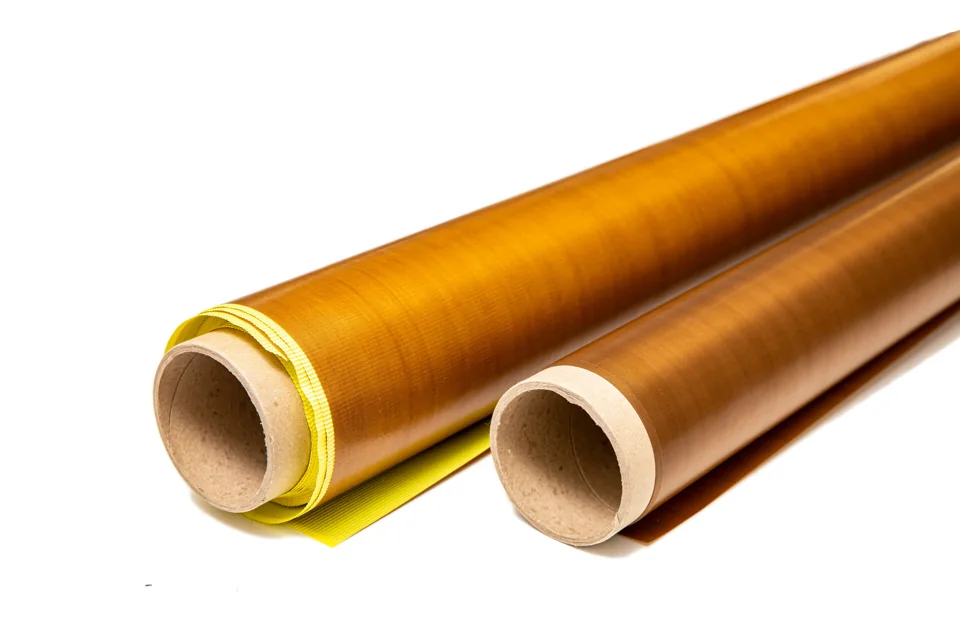
PTFE sheet, tape or conveyor belt?
Choose according to the material's function in the equipment. For self-adhesive versions, also check adhesive suitability for the substrate and operating conditions.
| You need to | See | Information for an enquiry |
|---|---|---|
| Cover a contact surface | PTFE sheets | Thickness, width, length, attachment and operating temperature. |
| Renew a narrow release layer | PTFE tapes and self-adhesive tapes | Contact width, thickness, roll length and attachment method. |
| Convey products through a line | PTFE conveyor belts | Width, circumference, joint, tracking and required airflow. |
Compare properties and applications of specific PTFE constructions.
Why reinforcement matters
The non-stick layer is only part of the product. According to Mateos, sheet 156 at 0.08 mm thickness has a PTFE content of 67 %. This fact alone shows why it cannot be equated with pure PTFE stock. For belts, glass and aramid bases are explicitly distinguished. For adhesive tape, the bonded interface also matters.
Temperature examples, rather than a universal value
Non-stick sheet 156 specifies −150 to +260 °C. Mateos lists the same range for glass-based mesh and solid belts, and −73 to +220 °C for aramid-based belts. These ranges are documented for the stated versions. For a self-adhesive product, adhesive behaviour on the specific substrate must be checked separately.
Chemical resistance, friction and electrical data
According to the supplier, laminated belts have a closed surface resistant to fats, chemicals and vapours penetrating the structure. This is not blanket approval for every medium. A numerical coefficient of friction and dielectric strength are not documented in the reviewed sheet tables. Request a technical data sheet for the specific version, medium concentration and operating conditions.
Benefits and selection
- Selection according to part function and attachment method
- Comparison of specific constructions instead of a single universal limit
- Dimensions and operating conditions for a technical enquiry
Technical specifications to check
Specific values vary by product and variant. When choosing, compare:
- supporting reinforcement or solid stock
- surface, adhesive and attachment method
- operating temperature and short-term peaks
- medium, loading and required documentation
Applications
Sheet covers a larger contact surface; tape covers a narrow strip. Self-adhesive construction provides attachment. A conveyor belt is a moving assembly with a joint and tracking. A rod is stock from which a part is subsequently machined.
Dimensions and delivery
For enquiries, distinguish the dimensions of the supplied material from those of the finished part. Attach a drawing, quantity, attachment method and description of operating conditions.
Frequently asked questions
Does +260 °C apply to every PTFE product?
No. The range includes constructions with different limits; the exact product, including reinforcement and adhesive, is decisive.
Is all PTFE suitable for electrical insulation?
Suitability must be based on the electrical parameters of the specific type. An antistatic version must not be confused with an insulator.
Product documentation
Specifications according to Mateos, verified on 1 October 2026. Confirm the specific variant and availability when ordering.