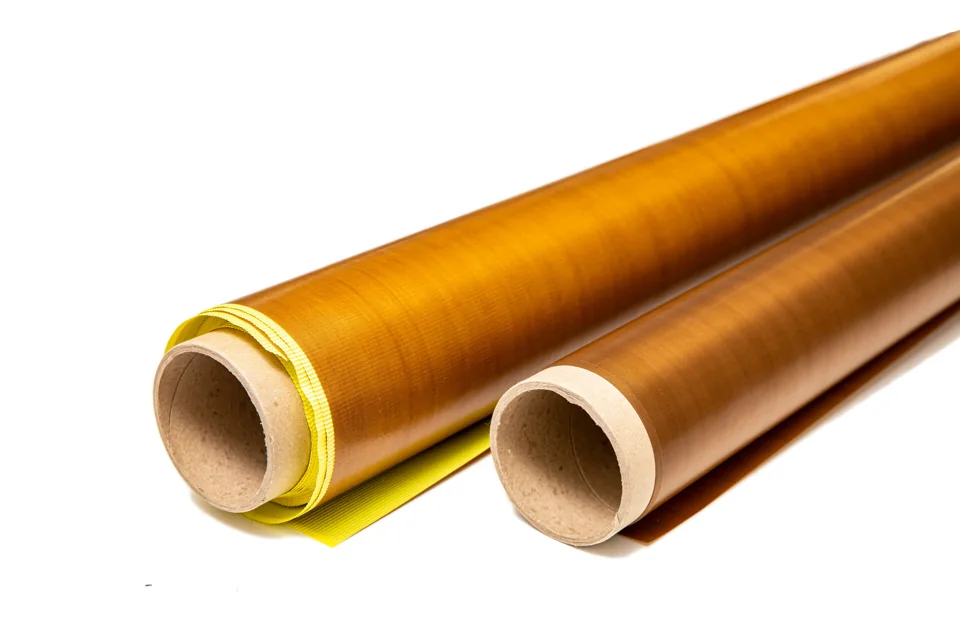
PTFE sheet, tape or conveyor belt?
Choose according to the material's function in the equipment. For self-adhesive versions, also check adhesive suitability for the substrate and operating conditions.
| You need to | See | Information for an enquiry |
|---|---|---|
| Cover a contact surface | PTFE sheets | Thickness, width, length, attachment and operating temperature. |
| Renew a narrow release layer | PTFE tapes and self-adhesive tapes | Contact width, thickness, roll length and attachment method. |
| Convey products through a line | PTFE conveyor belts | Width, circumference, joint, tracking and required airflow. |
Compare properties and applications of specific PTFE constructions.
Teflon sheet in the required size
Mateos supplies sheets with a standard width of 1 m and 30 m rolls; it also offers strips cut to the required width and other lengths. The overview lists thicknesses of 0.08; 0.12; 0.15; 0.25 and 0.32 mm. These cover different constructions, so select thickness together with whether the sheet should be adhesive or non-adhesive. The range includes brown and black antistatic versions; the properties of the black variant do not apply to the brown one.
Surface, temperature and properties of the specific sheet
For product 156 at a thickness of 0.08 mm, Mateos specifies a surface weight of 130 g/m², PTFE content of 67 % and temperature resistance of −150 to +260 °C. Non-adhesive PTFE-coated glass fabric sheet 157 at 0.12 mm has 260 g/m² and 58 % PTFE content, with the same stated temperature range. These figures describe particular sheets, rather than a universal property of every product labelled PTFE.
Chemical environment, friction and electrical insulation
A non-stick work surface helps release the material being processed. However, available product tables do not provide a numerical coefficient of friction, dielectric strength or chemical compatibility table. For chemical contact, send the medium name, concentration, temperature and contact time; for electrical applications, request data for the exact sheet type. An antistatic version must not automatically be considered an electrical insulator.
Benefits and selection
- Non-stick surface in contact with the product
- Choice of adhesive and non-adhesive versions
- Processing to suit the required application
Technical specifications to check
Specific values vary by product and variant. When choosing, compare:
- substrate type and surface finish
- sheet thickness
- roll or cut-piece width
- attachment method and working temperature
Applications
Sheets are used as technical release and protective surfaces, for example in production and packaging equipment. The version selected depends on the surface, movement and process temperature.
Dimensions and delivery
When enquiring, specify the required width, length and thickness. Available dimensions vary by the specific product in the online shop.
Frequently asked questions
Should I use self-adhesive or non-adhesive sheet?
Self-adhesive sheet is intended for attachment to a suitable substrate; non-adhesive sheet is used where the sheet is attached differently or replaced regularly.
Can you supply a custom size?
Mateos will check cutting options and size availability according to the chosen material.
Product documentation
Specifications according to Mateos, verified on 1 October 2026. Confirm the specific variant and availability when ordering.